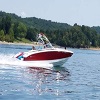
After a short 3 month season here on Lake Winnipeg, Friday was haul out day for my Cobalt 210. The dealer had delivered my new boat to the marina slip in the middle of June and while I have towed horse trailers (bumper pull and gooseneck) and a Sea-Doo regularly in the past, this was going to be the first time I hauled out my boat and trailered it into the city.
I learned a few things in the process and came away relatively unscathed.
I hauled my Sea-Doo out the week before and because the water is very low this year and was made worse by a sustained south wind last week, pushing the water north and dropping water levels another foot or so, I had to back the rear wheels of our minivan past the end of the concrete ramp and onto the crushed gravel to get the trailer in deep enough to retrieve the Sea Doo. A friend was hauling out a 30-year-old 18' bowrider with I/O and I found him paddling his boat from the slip to the trailer on the ramp because he said his prop had hit bottom.
This past Friday (September 14th), the winds were from the north and the water had returned to its "normal" low level. I carefully motored the boat out of the slip watching the depth sounder - and seeing sufficient depth in the main channel of the marina headed out on the lake for one last "toot" on the water. I brought the boat back into the marina and slowly approached the staging dock adjacent to the ramp. Watching the depth, when it got to 3.6', I shut the engine off and coasted to the dock, even though I had the outdrive partially trimmed up. I didn't want to risk hitting bottom with two SS props.
I tied the boat up and got the truck (Ram 1500) and trailer and backed the trailer down the ramp and into the water. Not having any experience, I completely submerged the center bunks and the trailer fender guards. I then went to the boat and tied a long bow line on and carefully motored the boat to the trailer, getting it lined up and motored up to the bow rest. So, the first problem was that there was a slight crosswind and the boat was floating a bit even though in contact with the lowest bunks. I winched the boat to the bow stop and then went to pull it out. The boat stopped as I was inching forward and I realized I hadn't trimmed the outdrive all the way up - oops.
So, I climbed back onto the boat and raised it all the way up and then back into the truck and tried to pull it out again. Again I felt resistance. Now, I started thinking; I don't have enough depth to get the boat out! How could this be though? The dealer had launched the retrieved the boat twice this season!
At this point, someone with more experience pointed out that I didn't have the truck and trailer exactly in the middle of the 12' wide ramp and that the dredged portion is right in the center. I took the boat off the trailer and the good Samaritan held the boat by the bowline just offshore while I repositioned the truck and trailer "dead center". This time, I stopped with the trailer fenders just slightly covered and the center lower bunks just visible under about 10" of water. I motored the boat onto the trailer and it held in place on the centerline of the trailer by the more exposed bunks. Much better than the first time - the boat wasn't floating around this time. I winched the boat to the stop.
I made sure the outdrive was completely up this time and pulled the boat and trailer out of the water. I was happy to find no damage to the propellers but I did put a small scuff on the leading edge of the lower unit. It is only about 2 or 3 inches long and I didn't gouge out the metal.
I took the boat to a nearby car wash and pressure washed off the hull and used light water pressure to clean off the lower unit. I wish I had a lift to keep this boat out of the water when not in use, but alas, no such facility in my marina, so the bottom of the boat will need a complete cleaning and polish before it is put away for the winter.
A word about towing: I pulled the boat into the city (65 miles) behind a 2018 Dodge Ram 1500 with a 5.7L V8. This rental truck pulled the boat fine, but I think if I were to purchase a Dodge Ram and was hauling more regularly, I'd pick the diesel option. The V8 has plenty of power, but it doesn't get into the top gear of its 8 speed automatic while pulling over 5,000 lbs and as a result burns a lot of gas at 65 MPH (26L/100KM or 9 MPG).
When I dropped the boat off and related the above to the service manager, he said; "there isn't one person I know who hasn't, at some point, forgotten to fully trim up the outdrive when pulling their boat out". I'm not sure that is true, but it did make me feel better.